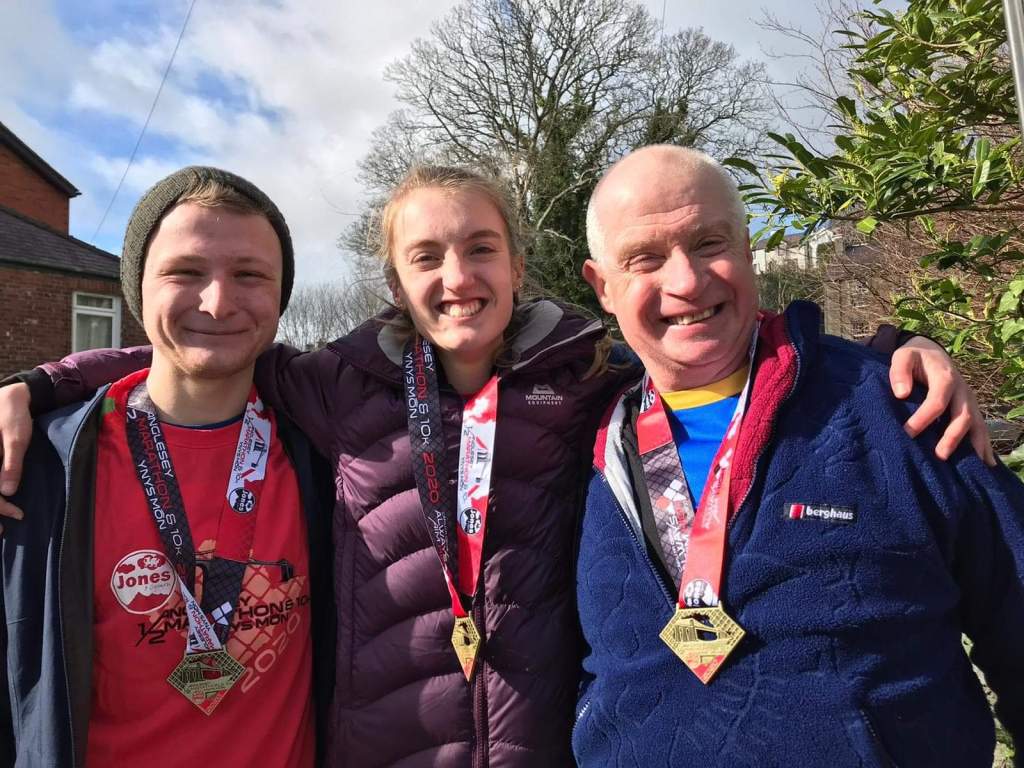
The past 2 weeks have been different from most as I’ve have only had 1 lecture but I’ve also had to look to marathon prep and compete in the Anglesey half marathon. But I can say without a doubt this has been my favourite 2 weeks so far.
Let’s start with the lecture. Week 5 has been all about motivation. Why do I want to run, what pulls me to it, what am I getting from all this? Firstly, there are 2 main types of motivation one is based on incentives/pulling factors and the stronger our incentives the more likely we are to engage in our desired behaviour, in my case running. Basically the carrot on stick we dangle in-front of ourselves

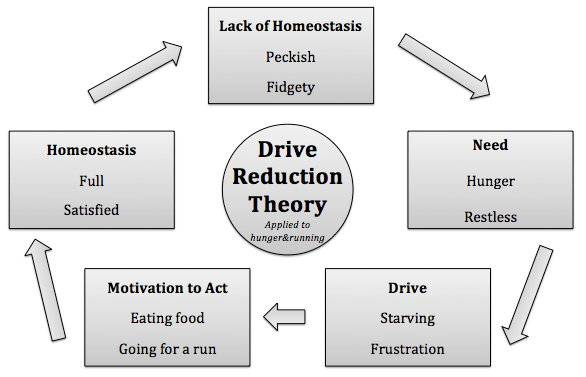
The other is Hull’s drive theory based on maintaining homeostasis. If there is a lack of homeostasis there’s lack of something within the body, this causes a need, which in turn creates a drive engage in a behaviour that satiates this drive. This is described as creating a push towards. These 2 theories of motivation can also work in tandem as food is both a need for the body as well as want, making it motivating. Because of this, I changed my reward after to my long runs to dark chocolate, which has been working quite well so far. However, these theories lack depth as they are minimalist in their views of what drives behaviour as they only account for basic needs and wants rather than more complex thought processes
Self-Determination Theory, on the other hand, takes more complex reasoning into account. It is based on the human need for Autonomy (having a sense of control), Competence (learning and the need for skills) and Relatedness (sense of belonging). So, in the context of my running, do I feel I have control over my training, am I improving my running form and increasing the distance I can run and do I feel I belong in my running group? The answer to all three yes which is likely to improve my performance and keep me engaged with running. But how does this link to motivation? Well, there are 6 types of motivation include within the theory base on a continuum of extrinsic motivation to intrinsic motivation.
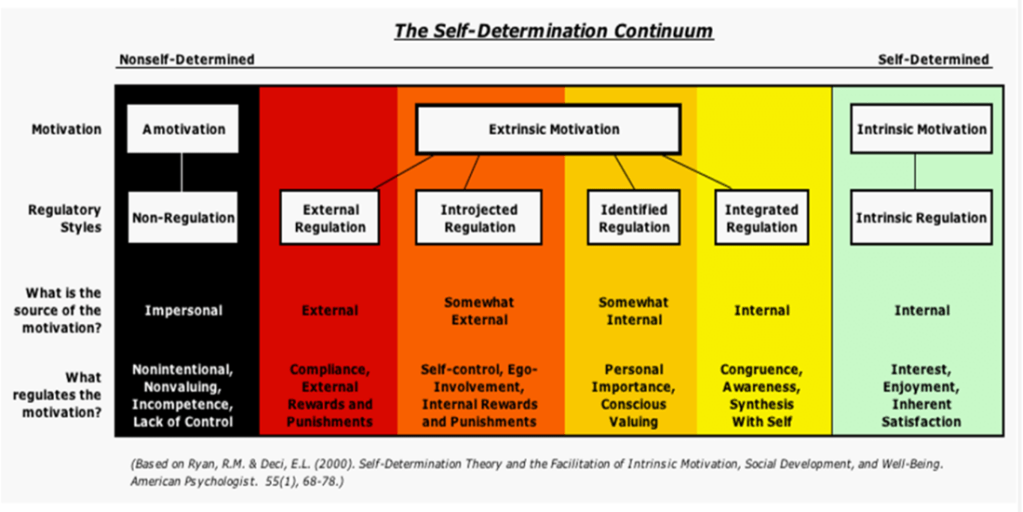
- Automotive motivation: No intention to perform a task.
- External motivation: To gain rewards or avoid punishment. So, this might be to gain the medal at the end of a race.
- Introjected approval: to gain other people’s approval or avoid guilt. This form of motivation, in relation to guilt, may be strong in the short term however is not a very reinforcing form of motivation in the long term as you aren’t engaging in behaviour for yourself.
- Identified: Motivation to act as the reason for the behaviour has importance. So, for example, if I was running the Liverpool marathon for a charity I’d be more motivated to do well
- Integrated: Motivation to engage in behaviour because it fits in with your beliefs and values. For me, I believe I should always be as healthy as I can and running helps me achieve that.
- Intrinsic: Motivation to engage in a behaviour because it’s reinforcing in itself. Running has recently become this for me and has been a big driver for me to go out on runs, as I actively want to go.
Out of these goals, integrated and intrinsic motivation have been shown to be the most likely to lead to behaviour as they have internalised value. So, I’ll be focusing mainly on these motivations in the coming weeks.
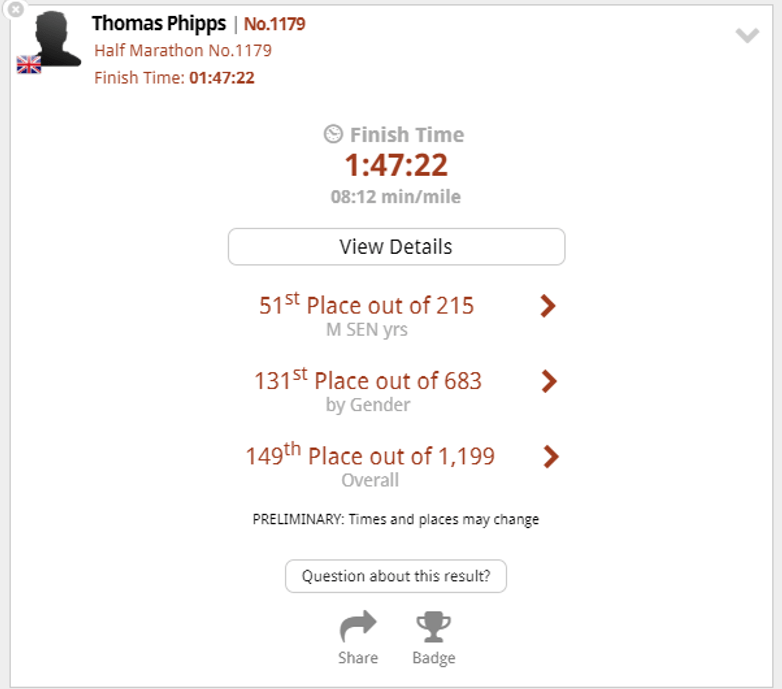
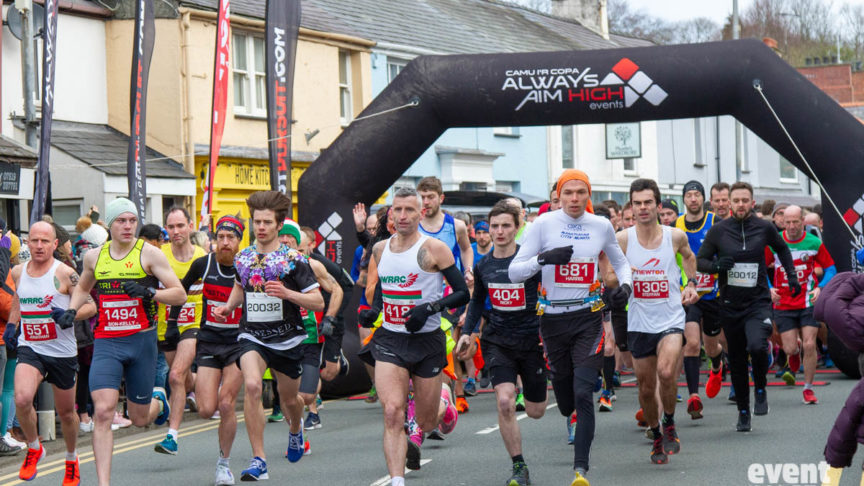
Now let’s talk about the big event of the past 2 weeks, the Anglesey Half Marathon (That was actually 13.8miles)!!! I’m extremely happy to say that I finished my first half marathon (and a bit) in 1:47:22, a time I’m really proud of. But I didn’t just rock up to the race with no plan and no strategy and get this time, I had techniques I prepared beforehand and focused on during my training sessions.
Firstly, throughout my runs in the past 2 weeks, I’ve been going into them focusing on associative techniques, where I focus on my form and the feeling of my body as I run to achieve improved performance, especially on shorter runs. This helped me achieve serial PBs: My fastest 10mile 1:17:50 and 10K 47:48. The downside of this, however, is that it’s psychologically taxing, especially on long runs that can last close to two hours. In addition, studies have found that none elite runners who use associative techniques may have lower endurance for long distances than those who use dissociative techniques as they are more likely to focus on pain and perceive higher effort levels. So, I decided to mix in some dissociative techniques as well, where I do the exact opposite! Isn’t this counter-intuitive? Don’t they cancel each other out? No!!!!! I’m getting the best of both worlds! By adding in stages of dissociative thinking (or not thinking as it may be) I allow my brain to rest and distract myself from pain or tiredness, boosting both my physical and mental endurance!
In these stages of dissociative thinking, I also add in positive self-talk, for example, “You got this! I’m smashing it right now! I’m crushing this marathon”. Although embarrassing to say (that’s why I whisper it) deliberate positive self-talk has been shown to reduce the perception of effort and improve endurance and I personally found helpful in providing a physiological boost during the half.
Finally, studies have shown that when we perceived someone of similar ability to us is competing against us (normally someone we know), it in turn can increase our performance, causing the Rival effect. But the problem with this is that over 1200 people competed in the Anglesey half and I only know people faster/slower than me that where competing. So how could I apply this? I chased people of course!! My strategy was to find people of a similar pace on the day and to keep chasing them until I passed them, giving me a mini victory each time. And it worked! Especially around mile 6 where I was constantly overtaking and being overtaken by a man in bright red shorts. Overall this strategy felt like my secret weapon on race day as it kept my concentrated and pushed me to work harder, all whilst feeling like a game.
So, would I change any of these strategies for the full marathon? I don’t think so. All my strategies on race day worked really well for me so I can’t wait to use them again on the big day!! The only thing I might change is my starting position, as I started in the back ¾ and got stuck for the first 20minutes of the marathon trying to overtake people. Other then that race day was amazing and I can’t wait to add another medal to my collection!!
Thanks for reading!
 From Mediocre to Marathon